Every year, around 12 million cars reach the end of their life on European roads. Roughly a third of them — some 3 to 4 million vehicles — simply vanish from the statistics, deregistered with no evidence of authorised recycling or legal export. The rest, about 4.3 million vehicles and 5 million tonnes of material in 2023, flow through Europe's authorised treatment facilities, where they are drained, dismantled, and shredded.
For two decades, we have treated this stream primarily as a bulk-materials problem: steel, aluminium, plastics, and the 85% reuse-and-recycling target of the old ELV Directive. That framing is now obsolete. The car of 2026 is not the car of 2000. It carries a lithium-ion battery with lithium, cobalt, nickel and graphite; permanent-magnet traction motors built on neodymium and dysprosium; power electronics; and two to four times the copper of its combustion-engine predecessor. In other words: the end-of-life vehicle has quietly become one of the richest anthropogenic deposits of critical raw materials (CRMs) in Europe.
The question is no longer whether CRMs are in the ELV stream. It is whether Europe can actually get them out.
What is actually in the stream?
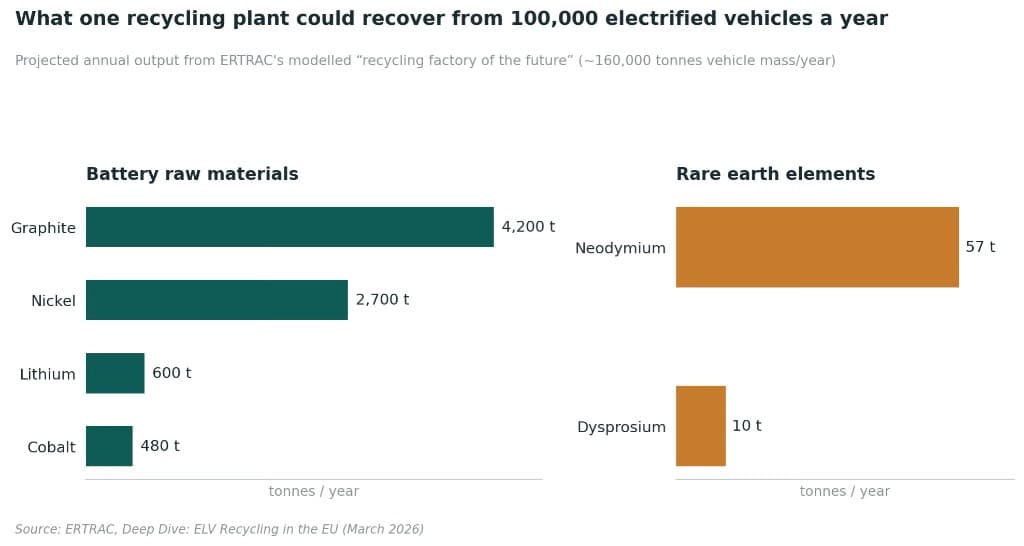
The numbers are concrete. ERTRAC's 2026 deep-dive on ELV recycling models a "recycling factory of the future" processing 100,000 electrified vehicles per year — about 160,000 tonnes of vehicle mass. From that single facility, the projected annual recovery is on the order of 600 tonnes of lithium, 2,700 tonnes of nickel, 480 tonnes of cobalt, 4,200 tonnes of graphite, and roughly 78 tonnes of rare earth elements, including around 57 tonnes of neodymium and 10 tonnes of dysprosium — primarily from high-voltage batteries and permanent-magnet e-motors.
Scale that against the millions of electrified vehicles that will start retiring in volume from the early 2030s, and end-of-life vehicles stop being a waste category and start looking like a strategic reserve. The European Commission's Joint Research Centre reached the same conclusion in its 2025 report on circularity measures for CRMs in vehicles, singling out rare earths, copper, lithium, cobalt and nickel as the priority targets.
So — can ELVs be a secondary source of CRMs?
Yes. But today, mostly they are not. Three gaps stand between the potential and the reality.
First, the leakage gap. A secondary resource you cannot collect is not a resource. With 3–4 million vehicles a year of "unknown whereabouts" and a large share of used vehicles exported outside the EU, a substantial fraction of Europe's future secondary neodymium, cobalt and copper is leaving the continent embedded in second-hand cars — often precisely the older, end-of-life-adjacent vehicles richest in recoverable material relative to their market value.
Second, the liberation gap. Today's shredder-based infrastructure was designed for bulk metals, not for CRMs. Rare-earth magnets that enter a shredder end up dispersed in the ferrous fraction, where the neodymium is functionally lost — and worse, copper contamination above roughly 0.1% downgrades the recovered steel itself. CRM recovery therefore depends on removing batteries, e-drive motors and magnets before shredding — which is exactly the labour-intensive dismantling step the current economics of authorised treatment facilities do not reward.
Third, the processing gap. Even a cleanly removed motor or battery needs somewhere to go. Europe's capacity for magnet-to-magnet rare-earth recycling and battery-material refining is growing but still nascent. Without downstream processing, "dismantled" just means "exported at a different point in the value chain."
Why the answer is changing now
Two pieces of legislation are converting this from an engineering discussion into a compliance reality.
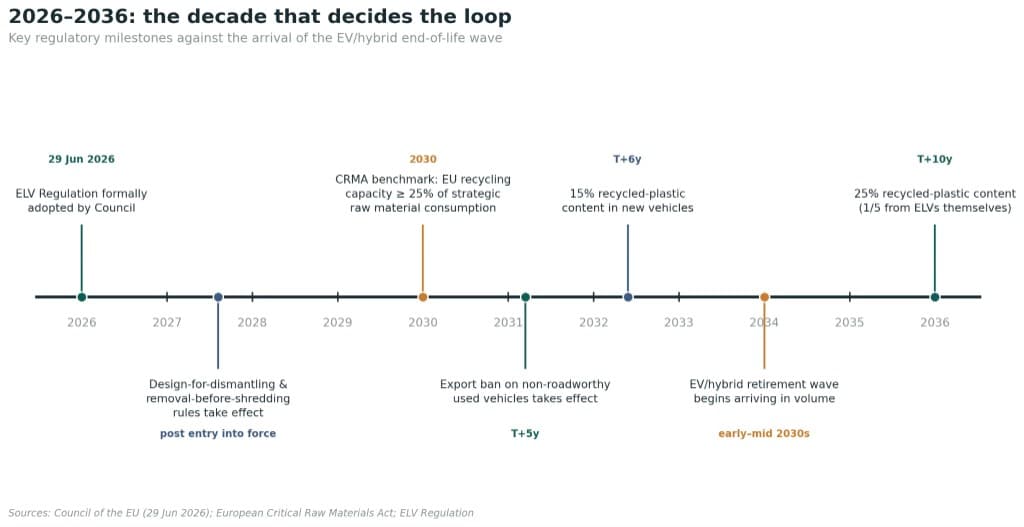
The Critical Raw Materials Act set the political benchmark: by 2030, EU recycling capacity should be able to cover at least 25% of the Union's annual consumption of strategic raw materials. That benchmark is unreachable without the vehicle stream — cars are simply where too much of the neodymium, cobalt and copper is.
More decisively, the new ELV Regulation, formally adopted by the Council on 29 June 2026, replaces the 25-year-old directive with directly applicable rules. It mandates recycled-plastic content in new vehicles (15% within six years, 25% within ten), requires removal of key components — batteries, e-drive motors — before shredding where shredding would destroy the material quality, extends producer responsibility across the whole vehicle lifecycle, and attacks the leakage problem: exporting used vehicles that are no longer roadworthy will be banned five years after the regulation enters into force.
Design-for-dismantling obligations close the loop at the front end: the vehicles type-approved under the new rules will be built to give their materials back.
The realistic verdict
Can end-of-life vehicles be a secondary source of critical raw materials? The honest answer is: they are the single most important secondary source Europe will have — on a delay, and only if the system is built now.
The delay is structural. The CRM-rich vehicles — EVs and hybrids — are only beginning to retire; the wave arrives in the 2030s. That is not a reason to wait. It is the reason to act, because the lead times run in parallel: recycling plants take years to permit and build, dismantling networks take years to professionalise, and the regulation's targets take effect on a fixed clock. The countries and companies that treat the 2026–2030 window as preparation time — building magnet-recovery capability, battery-recycling capacity, reverse-logistics and traceability systems — will own the loop when the volumes come.
There is also a message here beyond the EU. Vehicle-importing economies — Türkiye among them, with its substantial automotive industry and growing recycling sector — face the same arithmetic from the other side: every imported used vehicle is also an imported future deposit of copper, rare earths and battery materials. Positioning ELV infrastructure as CRM infrastructure is an industrial-policy opportunity, not just an environmental obligation.
The mine of the future is not only in the ground. Some of it is parked outside — and, as of this summer, European law finally treats it that way.
About Lumin Advisory
Lumin Advisory works with companies and institutions on critical raw materials strategy, circular economy and secondary resource recovery. If your organisation is thinking about what the new ELV Regulation and the CRMA mean for your value chain, let's talk.
Want to discuss this further?
Lumin Advisory works with companies and institutions on critical raw materials strategy, circular economy and sustainability evidence. Get in touch to talk about your specific challenge.
Get in Touch