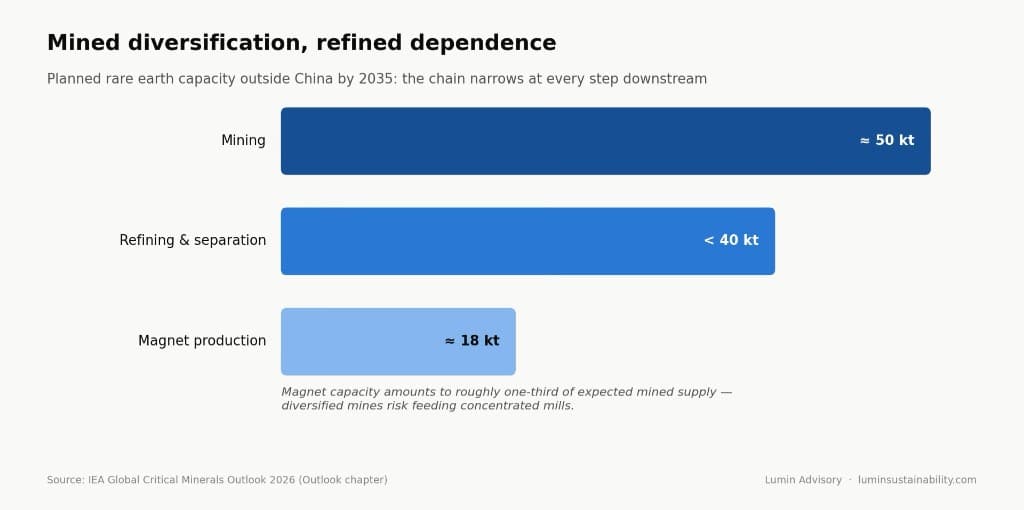
For years, the critical minerals debate in Europe has been framed as a geology problem: where are the deposits, who owns them, and how fast can we permit a mine. The IEA's Global Critical Minerals Outlook 2026 makes clear that this framing misses where value chains actually fail. Mining capacity is expanding across increasingly diverse regions. The chokepoint sits one step downstream — in refining, processing, and the industrial know-how wrapped around them.
Concentration has deepened where it matters most
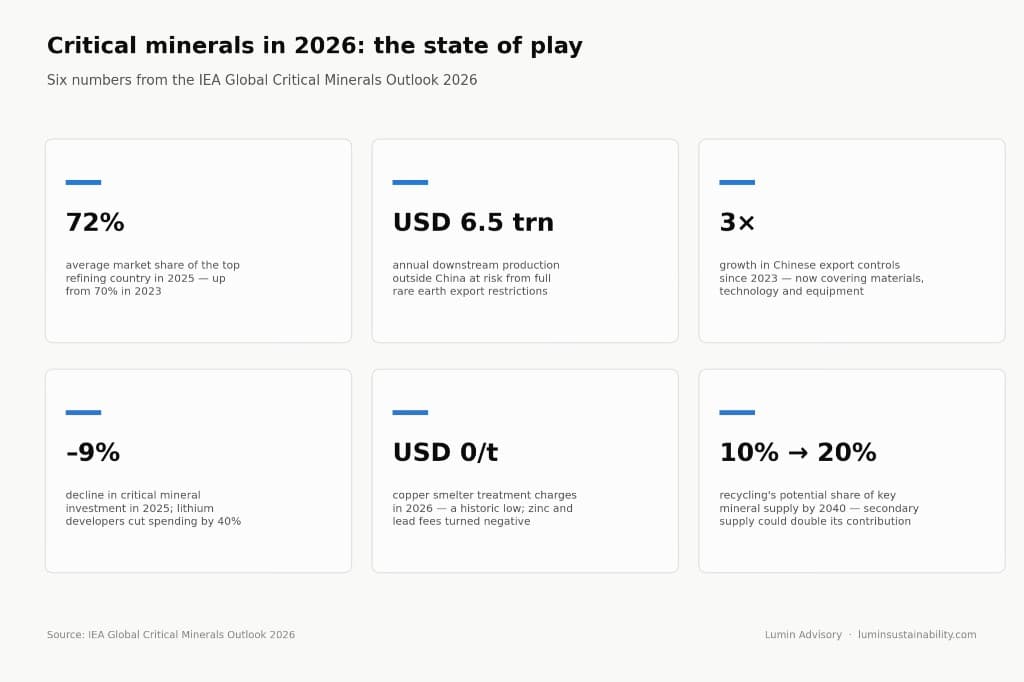
The headline numbers deserve a moment of honest attention. Across key critical minerals, the average market share of the top refining country reached 72% in 2025, up from 70% in 2023 — concentration is still rising, not falling. Over the past two years, the top refining countries accounted for more than three-quarters of all growth in refined supply. In manganese, nickel, and graphite, virtually all supply growth came from the already-dominant supplier. For gallium, graphite, manganese, and rare earths, a single country — China — refines over 90% of global supply.
This is no longer an abstract risk. Chinese export controls have roughly tripled since 2023, extending from heavy rare earths in April 2025 to battery materials, processing technologies, and processing equipment in October 2025. The last item is the one to sit with: the controls now cover not just the materials but the machines and methods needed to process them elsewhere. The IEA estimates that fully enacted rare earth export restrictions could put at risk some 6.5 trillion US dollars per year of downstream production outside China.
The market is already pricing in the asymmetry. European buyers have paid around five times Chinese domestic prices for gallium and heavy rare earths, and nearly three times for germanium. A two-tier market has emerged — one price inside the dominant supply chain, another for everyone outside it.
The IEA is not alone in this diagnosis
The 2026 Outlook lands on ground that a series of major studies has been preparing for years. The KU Leuven / Eurometaux study Metals for Clean Energy (2022) quantified Europe's looming primary-metals supply gap and delivered a sobering caveat on circularity: recycling cannot become a major domestic supply source before around 2040, because today's batteries and clean-tech products will only reach end of life in 10–15 years — which is precisely why recycling capacity and collection systems must be built now, not then.
The European Commission's JRC criticality assessments, which underpin the EU list of 34 critical and 17 strategic raw materials, reach the same structural conclusion: the EU's dependency is most acute at the processing stage, not extraction. The Draghi report on European competitiveness (2024) elevated raw material dependencies to a first-order economic security issue, and IRENA's Geopolitics of the Energy Transition: Critical Materials (2023) documented how processing — not reserves — is where market power actually concentrates.
Across these analyses, the convergence is striking: everyone measuring the problem finds the same pinch point. The disagreement, where it exists, is only about how fast the window to act is closing.
A heat map of the squeeze: not all minerals pinch in the same place
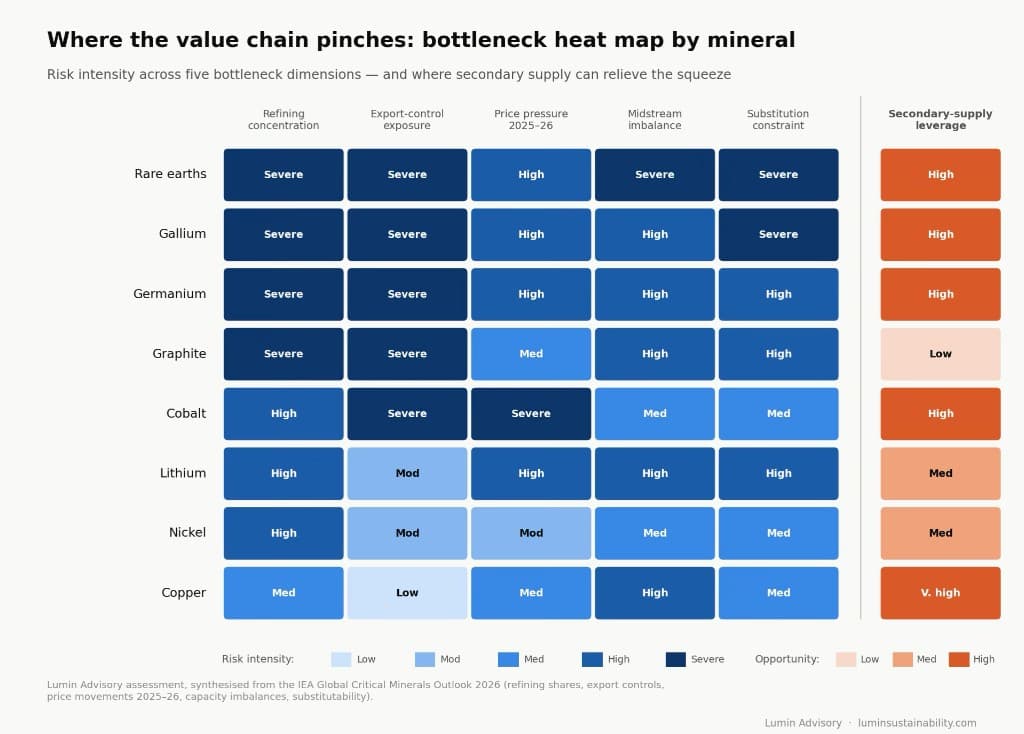
Aggregates hide more than they reveal, so we scored eight key minerals across five bottleneck dimensions: refining concentration, export-control exposure, price pressure over 2025–26, midstream capacity imbalance, and substitution constraints — alongside a sixth column: how much leverage secondary supply offers for each.
Three tiers stand out.
The severe cluster — rare earths, gallium, germanium, graphite. These combine refining concentration above 85–90%, active export controls, and hard substitution limits. They are also, not coincidentally, the minerals where European prices have decoupled furthest from Chinese domestic prices. For this cluster, diversification through new mines barely moves the needle — the constraint is separation, purification, and downstream conversion capacity, plus the metallurgical know-how to run it.
The conditional cluster — cobalt and lithium. Here the risk is policy- and price-driven: the DRC's export quotas sent cobalt up roughly 130%, and lithium prices doubled on energy-storage demand even as producers cut investment by 40%. The midstream imbalance is real — cathode capacity outside the dominant supplier is roughly a third of projected mining capacity — but the resource base and chemistry options (LFP, sodium-ion) give buyers more room to manoeuvre.
The economically-squeezed cluster — nickel and copper. Concentration risk looks moderate on paper, but the economics of the midstream are deteriorating fastest here: copper smelter treatment charges at zero, zinc and lead fees negative, smelter utilisation outside China below 70%.
The deepest bottleneck is knowledge
A refinery is not a building with equipment inside. It is an ecosystem: specialised technology, reliable access to critical reagents, precise process control and environmental management, deep metallurgical expertise, and direct integration with the downstream manufacturers who consume the output. Where any one of these is missing, projects take longer, cost more, and fail more often. The IEA quantifies the penalty: capital costs for refining projects outside dominant suppliers run 20–150% higher, operating costs on average 50% higher.
Europe's honest self-assessment must be that decades of offshoring did not just move factories — it moved learning. Process metallurgy is tacit knowledge, accumulated at operating scale, and it does not transfer through a licensing agreement. The knowledge still exists in Europe — but fragmented across research institutes, a thinning industrial base, and retiring specialists. What Europe lacks is not intelligence; it is operating practice.
What we recommend
For governments and policymakers: shift support from the mine gate to the midstream — offtake guarantees, contracts-for-difference, and price floors that let independent refiners survive a market their competitor can flood at will; treat recycling capacity as strategic processing infrastructure under the CRMA, not as waste policy; and fund operating practice — pilot lines, demonstration plants, and metallurgy education — with the same seriousness as capital equipment.
For industrial buyers and OEMs: map exposure at the level of individual process steps, reagents, and pieces of equipment — not countries of origin. A "diversified" supplier who depends on a single-source reagent or a controlled piece of processing equipment is not diversified. Build qualified second sources before the disruption, and contract secondary-material supply early: the recyclers now scaling will be capacity-constrained, and the buyers who qualified their material first will hold the advantage.
For investors and project developers: the scarce asset class of the next decade is not the deposit — it is permitted, operating midstream and recycling capacity in stable jurisdictions, with the workforce to run it. Evaluate projects on their position in the processing chain and their feedstock security, and demand the life-cycle and regulatory evidence (ISO 14040/44 LCA, EPDs, CRMA strategic-project eligibility) that turns a flowsheet into procurement-grade, bankable supply.
How Lumin helps organisations understand critical mineral supply chains
This analysis is the kind of work Lumin Advisory does for clients every week. We are a Berlin-based consultancy working at the seam between critical raw materials, circular economy, and sustainability evidence — founded on a decade of research and industrial practice in e-waste metallurgy and critical metal recovery.
Concretely, we support organisations in four ways. We map critical mineral value chains end to end — from ore and feedstock through refining, conversion, and components — identifying where a client's specific exposure sits and what disruption scenarios would mean for cost and continuity. We assess secondary raw material opportunities: quantifying critical metal content in e-waste and industrial streams, evaluating recovery routes and their economics, and positioning projects under the EU Critical Raw Materials Act. We build the evidence layer that markets and regulators increasingly demand — ISO 14040/44 life-cycle assessment, product carbon footprints, EPDs, and CBAM readiness. And we help clients navigate the funding and policy landscape, from Horizon Europe consortia to national instruments.
If your organisation is trying to understand where its critical mineral exposure really sits — or how to turn Europe's above-ground resources into supply — we would be glad to talk.
Want to discuss this further?
Lumin Advisory works with companies and institutions on critical raw materials strategy, circular economy and sustainability evidence. Get in touch to talk about your specific challenge.
Get in Touch